
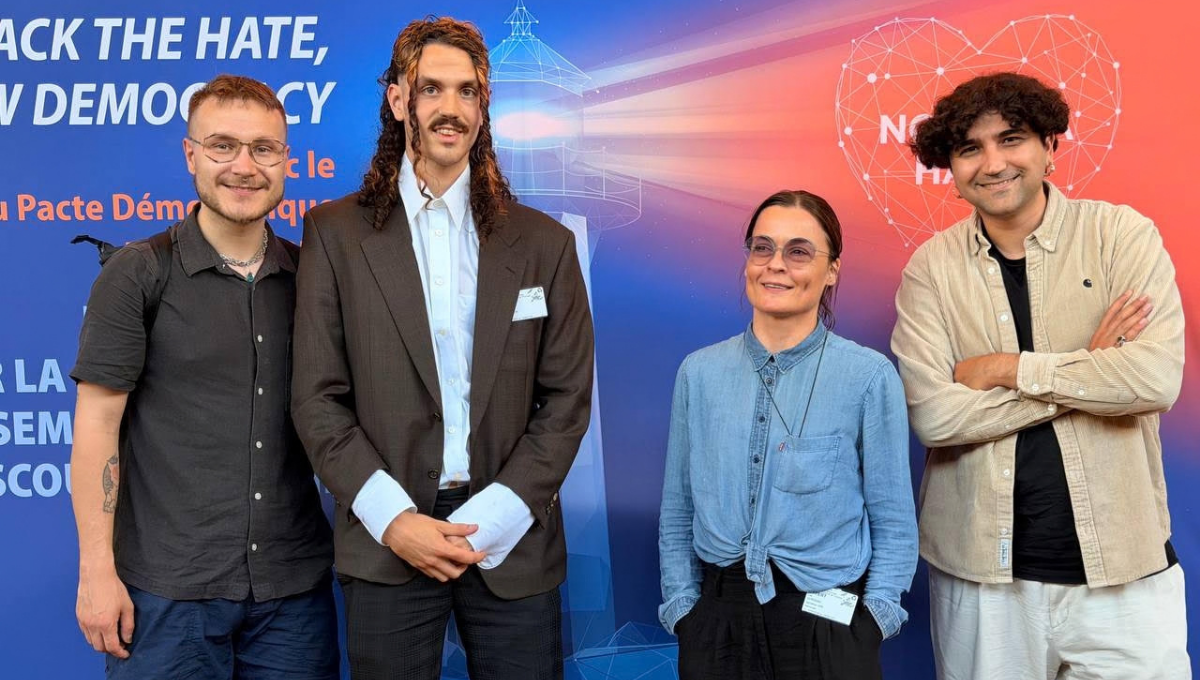
The Council of Europe’s Democracy Hackathon was held June 17–19, 2026, in Strasbourg as part of the No Hate Speech Week , with the theme Hack the Hate, Renew Democracy!. The event brought together policymakers, civil society actors, and young innovators to develop practical tools to combat online hate speech.
The finals featured 20 teams and 71 participants from 15 countries, including Finland. Finland was represented by the NoBS team: Joonatan Myllys, Arsham Soltani, Jenna Jauhiainen (remotely), Vivian Wong (remotely), Jules Uusinarkaus, and Liisi Soroush. During the hackathon, the team built a pilot tool, an observatory, designed primarily for researchers, journalists, and civil society organizations. The working group placed second in its category and received a lot of positive feedback from the council’s experts.
The KUORO project addresses the need to develop a real-time monitoring system for Finnish-language online communication based on open data, open source code, and Triage-DP anonymization, which protects privacy.
The system measures two dimensions: hate speech and its coordination. With regard to hate speech, it examines what is said, to whom, and how seriously. Regarding coordination, the analysis assesses whether the same messages come from many independent actors or from a few entities acting in concert. Together, these factors indicate whether the issue is a widely held opinion or an attack organized by a small group. The working group will publish the project’s methodology, classification code, and aggregated, anonymized data under an open license.
Article 10 of the European Convention on Human Rights protects freedom of expression, but Article 17 prevents the Convention from being used to override other rights. The EU Digital Services Act (DSA) requires the largest platforms to assess and mitigate risks to fundamental rights and elections. The Committee of Ministers of the Council of Europe recommends (CM/Rec(2022)16, §59) that member states also collect information on harmful communication that does not meet the legal threshold for a crime. In October 2025, ECRI noted that hate speech in Finland has reached a critical level both online and in politics.
Finland’s own data set is limited. The Ministry of Justice’s EU-funded Facts Against Hate project monitored online hate speech for only two months, from September to October 2020. The monitoring was carried out by Utopia Analytics Oy, in which, according to Iltalehti, a member of parliament from the Finns Party held a 38 percent stake.
The project is now moving forward toward the 2027 parliamentary elections. The proposed initiative focuses on online hate directed at female and non-binary candidates, and Open Knowledge Finland would serve as its operational and collaborative platform. Potential partners for the project are currently being identified.